I Tested 4 AI Video Generators Using Hindi Prompts: Wan 3.0 vs Grok Imagine 1.5 vs Veo 3.1 vs Gemini Omni Flash
I Tested 4 AI Video Generators Using Hindi Prompts: Wan 3.0 vs Grok Imagine 1.5 vs Veo 3.1 vs Gemini Omni Flash
Testing period: October 2026
Use case: Hindi-language video generation, short-form content, AI advertising, and reference-based video creation
Models personally tested: Alibaba Wan 3.0, xAI Grok Imagine Video 1.5, Google Veo 3.1, Google Gemini Omni Flash
Additional models researched: ByteDance Seedance 2.5, Kling 3.0, MiniMax H3, HappyHorse 1.1, Runway Gen-4.5, Luma Ray3.14, and Pika 2.5
Why I Tested These Models
AI video generation is moving beyond producing visually impressive five-second clips. The more interesting question now is whether these systems can create usable content consistently, follow detailed instructions, preserve reference imagery, and generate natural dialogue in languages other than English.
I was particularly interested in Hindi.
For Indian businesses and content creators, a useful model needs to understand more than cinematic vocabulary. It needs to handle local speech, conversational delivery, recognizable environments, advertising instructions, and potentially regional accents.
My goal was to explore which models offered the best combination of output quality, generation cost, speed, and controllability.
I spent time experimenting with four models, reviewing their documentation and generation parameters, and watching comparisons involving other leading models.
My preliminary finding: Wan 3.0 delivered the best results in my limited hands-on comparison, with Grok Imagine Video 1.5 coming second. Veo 3.1 was the slowest in my tests and did not produce the strongest result for my particular prompt.
That is an observation from my experiments, not a claim that Wan is universally better.
Models Tested
| Model | Developer | Hands-on testing | General focus |
|---|---|---|---|
| Wan 3.0 | Alibaba | Yes | Multimodal generation, longer clips, reference-based workflows |
| Grok Imagine Video 1.5 | xAI | Yes | Fast video generation, motion, integrated audio |
| Veo 3.1 | Yes | Cinematic video, audio, frame and reference control | |
| Gemini Omni Flash | Yes | Fast generation, multimodal input, conversational editing | |
| Seedance 2.5 | ByteDance | No | Extended storytelling, references, multimodal editing |
| Kling 3.0 | Kuaishou | No | Cinematic motion, multimodal generation, native audio |
| MiniMax H3 | MiniMax | No | Multimodal generation, 2K video, native stereo audio |
| HappyHorse 1.1 | Alibaba Cloud | No | Text, image and reference-to-video generation |
| Runway Gen-4.5 | Runway | No | Cinematic control, motion quality, prompt adherence |
| Ray3.14 | Luma | No | Image animation, motion consistency, video modification |
| Pika 2.5 | Pika | No | Short-form creative video and effects |
The remaining sections distinguish my hands-on findings from capabilities reported in official documentation.
Prompts I Used
I tested the models using Hindi-language instructions and a common underlying prompt to make the comparison more meaningful.
The experiments covered three generation modes:
- Text-to-video: Producing a video from a written description.
- Image-to-video: Animating a supplied image.
- Reference-based generation: Using visual references to guide the generated result.
The objective was to compare how different models interpreted broadly similar creative instructions.
Original Hindi test prompt
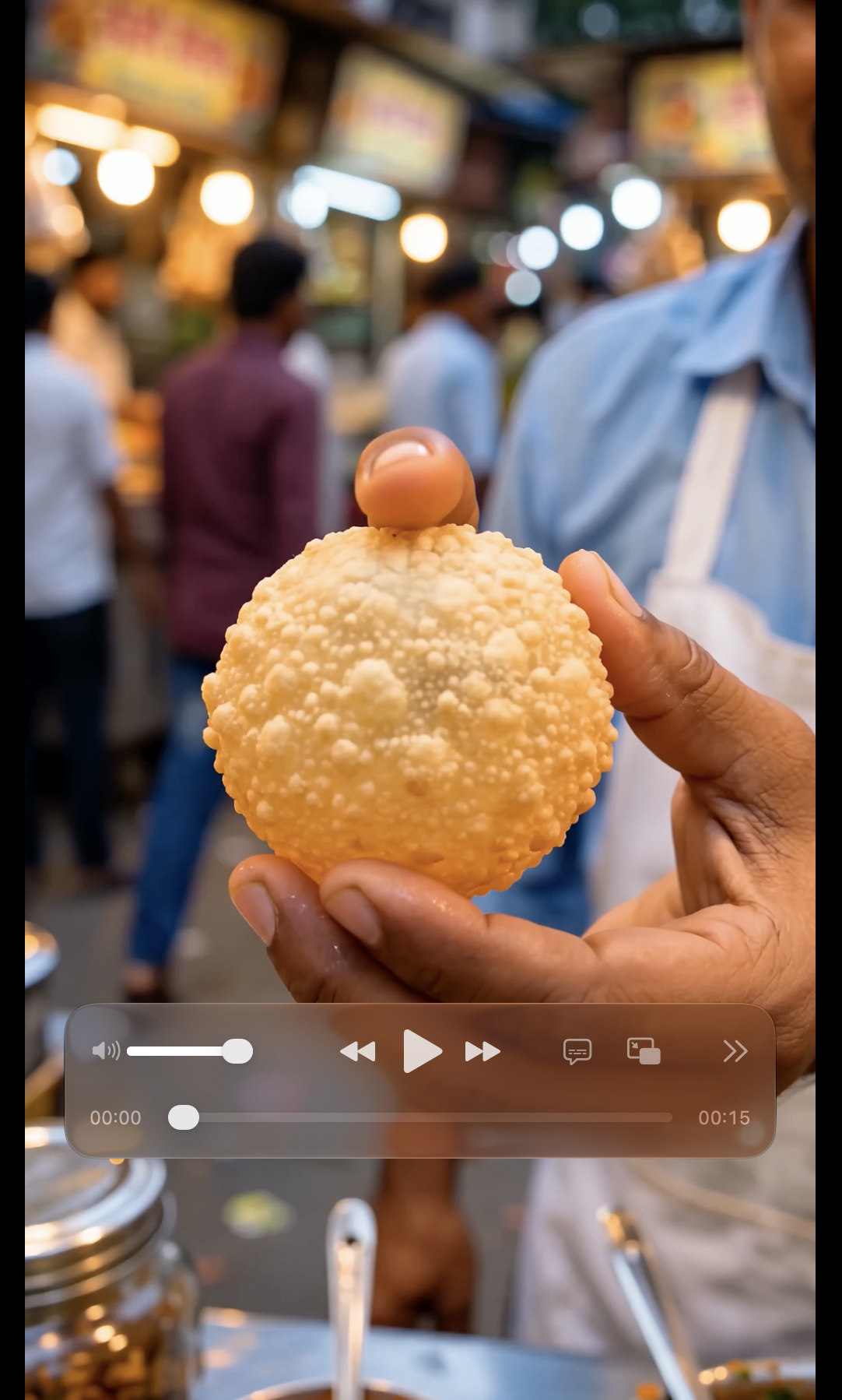
Use realistic human movements, authentic Indian street-food preparation, rich food textures, natural facial expressions, and professionally composed cinematic shots. ## Scene 1: The Craving (0-4 seconds) **Visuals:** Begin with an extreme close-up of a perfectly round, golden, crispy golgappa resting in the vendor's hand. The vendor gently cracks a hole in its top using his thumb. The camera slowly pushes forward as he scoops freshly mashed potato and chickpea filling into the golgappa. **Camera Motion:** Smooth macro push-in, shallow depth of field, subtle handheld realism. **Surroundings:** A busy Indian evening market, warm lights, softly blurred pedestrians and street-food stalls. **Hindi Voiceover:** "गोलगप्पे खाने का मन है? तो फिर इंतज़ार किस बात का?" **Audio:** Light upbeat Indian percussion begins, with subtle street-market ambience. ## Scene 2: The Flavor Explosion (4-8 seconds) **Visuals:** Cut to an ultra-close slow-motion shot of the vendor dipping the stuffed golgappa into a shiny steel bowl of vibrant green, spicy mint water. Tiny droplets splash naturally as the golgappa fills. Show detailed textures of crispy puri, spicy potato mixture, green coriander, and glossy tamarind chutney. The vendor lifts the overflowing golgappa toward the camera. **Camera Motion:** Macro tracking shot following the vendor's hand, brief slow-motion water splash, smooth focus pull from filling to golgappa. **Lighting:** Warm natural highlights, rich appetizing food colors. **Hindi Voiceover:** "करारे गोलगप्पे, चटपटा मसाला और ऐसा तीखा-मीठा पानी कि दिल खुश हो जाए!" **Audio:** Crisp water splash with a subtle musical accent. ## Scene 3: The Happy Customer (8-12 seconds) **Visuals:** Cut to a young Indian woman in her mid-20s standing beside the stall, smiling as the vendor serves her a fresh golgappa on a small disposable leaf bowl. She eats the golgappa in one bite, reacts naturally to the burst of spicy, tangy flavor, smiles with delight, and gestures enthusiastically for another. Her friends laugh and smile in the background. **Camera Motion:** Medium close-up transitioning into a gentle handheld tracking shot. Capture genuine facial expressions without exaggerated acting. **Hindi Voiceover:** "एक खाओगे, तो बार-बार खाने आओगे!" **Audio:** Satisfying crispy crunch, subtle laughter, lively background music. ## Scene 4: The Call to Action (12-15 seconds) **Visuals:** Cut to an appealing hero shot of five freshly prepared golden golgappas arranged neatly on a traditional Indian serving plate, accompanied by small bowls of vibrant green spicy water and dark brown tamarind chutney. The camera smoothly pulls backward, revealing the cheerful vendor standing behind his busy, colorful golgappa stall. He smiles and presents the plate toward the viewer with an inviting gesture. Finish with a clean hero frame suitable for placing the shop's name and location as an overlay. **Camera Motion:** Smooth cinematic pull-back, ending on a stable composition. **Hindi Voiceover:** "तो आज ही आइए [दुकान का नाम] पर! स्वाद ऐसा, जो याद रह जाए!" **Audio:** Upbeat musical finish, natural market ambience. ## Audio and Voice Direction - Use one consistent, lively Indian male Hindi voiceover throughout. - Native, conversational Hindi pronunciation with the energy of a professional Indian street-food advertisement. - Deliver the dialogue briskly and enthusiastically, with minimal pauses, to fit 15 seconds. - The narrator is off-camera, so no lip-sync animation is required. - Maintain consistent background music and street ambience across all scenes. - Synchronize the sounds of cracking puri, pouring pani, and crunchy bites with the visuals. - Keep dialogue clearly audible above music and ambient noise. ## Visual Consistency and Quality Requirements - Photorealistic 4K-quality detail with natural motion at 24 fps. - Maintain the same vendor, stall, clothing, lighting, and general surroundings across cuts. - Golgappas must look authentic to Indian street food, not generic spherical snacks. - Physically realistic hands, utensils, water splashes, eating actions, and facial expressions. - Vibrant, appetizing colors without excessive saturation. - Avoid distorted fingers, unnatural mouth movements, floating objects, flickering, changing stall designs, and artificial-looking faces. - No subtitles, random text, watermarks, brand logos, or unwanted graphics. - Preserve a continuous, professionally mixed audio bed through every camera cut. **Final Objective:** Create a visually irresistible, authentic Indian street-food advertisement that makes viewers immediately crave golgappas and want to visit the featured stall. ## Photorealism, Human Authenticity & Scene Consistency **Critical Requirement:** The entire video must look like authentic live-action footage filmed with a professional cinema camera in a real Indian street market, not AI-generated content. **Human Realism:** - Every person must appear indistinguishable from a real human, with natural Indian facial features, realistic skin pigmentation, visible pores, fine facial hair, subtle wrinkles, and authentic skin texture. - Preserve natural facial asymmetry, realistic eye reflections, believable teeth, and detailed hair strands. - Human expressions, blinking, breathing, chewing, and gestures must follow natural anatomical movements. - Avoid overly smooth, plastic-like skin, artificial beauty filters, exaggerated expressions, uncanny faces, and robotic movements. **Scene, Environment & Surface Textures:** - Maintain physically accurate textures on stainless-steel utensils, glass jars, clothing, food, countertops, and surrounding buildings. - Include realistic environmental imperfections such as subtle dust, fabric wrinkles, water droplets, fingerprints on steel surfaces, and natural wear on the stall. - Ensure accurate contact shadows, ambient occlusion, realistic reflections, and consistent light direction across all shots. - Background pedestrians must move naturally, with realistic crowd behavior, proper depth perception, and no duplicated or morphing faces. - All objects must maintain consistent shape, size, position, and material properties throughout the video. **Camera & Cinematography Realism:** - Simulate genuine optical characteristics of a professional cinema camera, including natural depth of field, realistic motion blur, subtle lens imperfections, and physically accurate exposure. - Use subtle handheld camera micro-movements rather than perfectly artificial floating camera motion. - Maintain accurate perspective, believable focal lengths, and natural transitions between foreground and background. - Preserve temporal consistency between frames, especially for faces, hands, clothing, food textures, and moving objects. - No frame flickering, texture crawling, face morphing, object deformation, or inconsistent shadows. **Food & Physical Interaction Realism:** - Golgappas must have naturally uneven, porous, crispy surfaces rather than perfectly smooth spherical shells. - Show believable finger pressure while cracking the puri, authentic filling movements, realistic water displacement, and physically accurate liquid splashes. - Ensure hands interact correctly with utensils and food, with realistic finger articulation and grip. - Eating and chewing actions must look completely natural, without unnatural mouth deformation. **Final Quality Standard:** The finished video should resemble a professionally shot Indian street-food commercial captured on location with real actors, real food, authentic surroundings, and natural lighting. Prioritize human believability, physical accuracy, texture fidelity, and frame-to-frame consistency over exaggerated cinematic effects. It should never resemble a 3D render, animation, synthetic advertisement, or AI-generated video.
I recommend using the original prompt verbatim rather than reconstructing it from memory. Small differences in dialogue, camera instructions, and scene composition can materially affect the results.
A follow-up prompt for reproducible testing
The following is a proposed benchmark prompt, not the exact prompt used in my original experiments.
Create a realistic 15-second vertical advertisement
for an Indian sweets shop.

Scene: A modern but authentic Indian mithai shop
during the festive season.

Character: A young Indian shopkeeper speaking
directly to the camera.

Dialogue (Hindi):
"इस त्योहार, मिठास हो कुछ खास!
हमारी दुकान पर आइए और अपनों के साथ
खुशियां बांटिए।"

Camera: Medium shot, slow cinematic push-in.

Lighting: Warm festive lighting, natural skin tones.

Requirements:
- Natural Indian Hindi pronunciation
- Accurate lip synchronization
- Consistent character appearance
- Realistic facial expressions
- No unintended subtitles or extra dialogue
- Preserve the appearance of supplied reference images
- 9:16 aspect ratio
This would be useful for evaluating models under more controlled conditions.
Tasks and Results
Task 1: Text-to-video generation
Objective: Determine which model could turn a Hindi creative prompt into a convincing short video.
I used a common prompt concept across the models and compared their generated outputs.
Wan 3.0
Wan 3.0 produced my favorite result from the experiment.
Its output was the most convincing overall for the specific creative direction I was testing.
What stood out was that I preferred its final generated video over the outputs from the other models, even though the available generation options and resolutions were not necessarily identical.
Alibaba's documentation also makes Wan interesting from an engineering perspective. The Wan 3.0 API supports generation durations of up to 30 seconds, resolution options including 480p, 720p and 1080p, reference audio, and several image-based generation workflows.
The availability of longer clips is particularly relevant for advertisements that need an introduction, a product shot, dialogue, and a closing scene.
My assessment: Best output in my initial hands-on comparison and my first candidate for further experimentation.
Grok Imagine Video 1.5
Grok Imagine came second in my testing.
Its output was competitive enough that I would include it in another round of evaluation rather than selecting Wan without further testing.
xAI's Video 1.5 documentation describes improvements to motion, physics, audio generation, and synchronization.
The current API also supports text-to-video, image-to-video, reference-based controls, and video generation at resolutions up to 1080p.
One of Grok's interesting advantages is its API-oriented workflow. It exposes generation through asynchronous requests, which makes it suitable for programmatic pipelines that submit jobs and retrieve results.
My assessment: Strong alternative to Wan, particularly worth benchmarking when generation speed and programmatic integration matter.
Google Veo 3.1
Veo 3.1 was the most disappointing result relative to my expectations.
It took the longest to generate among the outputs I compared, and the resulting video was not as good as Wan's or Grok's for the particular prompt.
This is not a general verdict on Veo's quality.
Veo supports native audio generation, reference images, first-and-last-frame control, and 4K output. It also has Standard, Fast, and Lite variants with materially different pricing and performance characteristics.
An additional caveat is language support. Google's Vertex AI documentation lists English as Veo 3.1's supported prompt language. Since my experiments were conducted in Hindi, that may have affected the comparison.
A fair follow-up would test the same Hindi dialogue using both a fully Hindi prompt and an English scene description with Hindi dialogue instructions.
My assessment: Technically capable, but not the best fit in my initial Hindi-only experiment. I would not rule it out without testing other prompts and variants.
Gemini Omni Flash
I also experimented with Google's Gemini Omni Flash.
Its design is interesting because it combines video generation with conversational editing.
Rather than treating each generation as an isolated request, the model can support iterative instructions such as adjusting a shot, extending a scene, or modifying an existing video.
Google's Gemini Omni 1.1 Flash documentation describes support for text, images, audio and video as inputs, as well as video extension and keyframe interpolation.
I did not collect enough standardized comparative evidence to assign Omni Flash a reliable rank relative to Wan, Grok and Veo.
My assessment: Worth further exploration for iterative editing and production workflows, but my limited testing does not support a definitive quality ranking.
Task 2: Image-to-video
Objective: Understand how effectively the models could animate existing visual material.
This matters because production content rarely starts from a blank prompt.
An actual advertising workflow might already contain a product photograph, storefront image, character reference, or approved brand creative.
A useful image-to-video model should preserve the important parts of that input rather than inventing a completely different scene.
I explored image-driven generation as part of my testing, but did not independently record enough results to rank every model specifically on image fidelity.
For a more formal experiment, I would evaluate:
- Preservation of product identity and colors
- Stability of faces and character appearance
- Accuracy of requested movement
- Camera motion and scene continuity
- Unwanted distortions or changes to reference material
The distinction between producing an attractive video and producing an accurate video is extremely important for commercial content.
A visually impressive generated advertisement is still a failure if the product no longer resembles the actual product.
Task 3: Reference-based generation
Objective: Explore how reference inputs help control the output.
Reference-based generation is particularly interesting for repeatable creative production.
Consider generating ten advertisements for the same business. Each video might contain a different script, location, or camera movement, but the brand identity and characters should remain consistent.
I explored reference-based workflows and studied the available API parameters and prompting guides.
Wan's generation controls were particularly interesting to examine, and the documentation helped me understand how its inputs could fit into a larger content-generation pipeline.
My experiments were too limited to establish a reliable cross-model identity-consistency score.
Nevertheless, reference fidelity is one of the first things I would test in a production evaluation because it directly affects the amount of manual correction required.
Task 4: Hindi and regional-language suitability
Objective: Evaluate video generation for Hindi-first creative content rather than relying exclusively on English-language demos.
All of my hands-on testing was conducted using Hindi prompts.
This was intentional.
Most public demonstrations of video models focus on English instructions, cinematic landscapes, action sequences, or visually striking scenarios.
For the Indian market, there are additional questions:
- Does the model understand Hindi creative instructions?
- Can it produce natural-sounding dialogue?
- Does the spoken dialogue match the requested words?
- Are mouth movements aligned with speech?
- Can it handle Indian pronunciation and local cultural context?
- Does performance change when the instructions mix English and Hindi?
I did not complete a systematic evaluation across multiple Hindi prompts, regional languages, or accents.
Therefore, I cannot claim that any model is conclusively the best for Hindi speech generation.
My initial preference for Wan reflects overall output quality in the samples I generated, not a measured Hindi speech-accuracy benchmark.
Cost: What I Actually Observed
Generation quality matters, but cost becomes a major factor when generating content repeatedly.
These are the approximate generation costs I tracked during my experiments.
| Model | Video duration | Resolution | Approximate observed cost | Cost/second |
|---|---|---|---|---|
| Wan 3.0 | 15 seconds | 1080p | $3.00 | $0.20 |
| Grok Imagine 1.5 | 15 seconds | 480p | $2.20 | $0.147 |
| Veo 3.1 | 8 seconds | 4K | $2.50 | $0.313 |
These are my approximate testing figures, not a standardized comparison of official API prices. They may reflect the particular platform, configuration, or billing arrangement used.
Official API pricing cross-check
I also checked current provider documentation to understand the underlying economics.
| Model / variant | Published API rate | Example output cost |
|---|---|---|
| Wan 3.0, 1080p, Singapore | $0.20/sec | $3.00 for 15s |
| Grok Imagine Video 1.5, 480p | $0.08/sec | $1.20 for 15s |
| Grok Imagine Video 1.5, 720p | $0.14/sec | $2.10 for 15s |
| Veo 3.1 Standard, 4K | $0.60/sec | $4.80 for 8s |
| Veo 3.1 Fast, 4K | $0.30/sec | $2.40 for 8s |
| Gemini Omni Flash, 720p | Approximately $0.10/sec | Approximately $1.00 for 10s |
The difference between observed and published pricing illustrates why it is necessary to record the provider, model variant, resolution, and billing method.
In particular, my approximate $2.20 Grok figure does not correspond directly to xAI's published 480p Video 1.5 base rate. Similarly, the approximate Veo figure is closer to Google's Fast 4K rate than its Standard 4K rate.
Input media charges, provider markups, and configuration differences may also affect the final price.
The key takeaway is that quoted prices are not directly comparable when resolutions, video durations and model variants differ.
The real production metric: cost per usable video
Raw generation cost is only one part of the equation.
Suppose one model costs 3.
The cheaper model is not necessarily more economical if it takes several attempts to produce an acceptable result.
A better metric is:
Cost per usable video =
Total generation spend /
Number of outputs accepted for use
For example, in a hypothetical test:
| Model | Cost per attempt | Attempts | Accepted outputs | Cost per accepted video |
|---|---|---|---|---|
| Model A | $2.00 | 10 | 3 | $6.67 |
| Model B | $3.00 | 10 | 8 | $3.75 |
These are illustrative numbers, not measured results from my experiments.
They demonstrate why production teams should optimize for successful output rather than simply minimizing the price of an API request.
Other Models I Researched
I also looked beyond the four models I personally tested to understand where the broader market is heading.
The following findings come from model documentation, published announcements, and third-party comparisons rather than my own generated clips.
1. ByteDance Seedance 2.5
Seedance 2.5 was one of the models I most wanted to try.
ByteDance officially introduced it in July 2026, emphasizing longer video generation, multimodal references, and stronger editing controls.
According to its documentation, Seedance 2.5 supports:
- Clips up to 30 seconds in a single generation
- Multiple rounds of video extension
- Up to 30 reference images
- Up to 10 reference video clips and 10 audio clips
- Timestamp-level editing controls
- Joint audio-video generation
These capabilities are attractive for more complex advertisements and stories.
For example, a creative workflow might involve several reference images of a product, a particular visual style, a supplied audio reference, and an instruction to maintain consistency across multiple shots.
Rather than generating each scene independently, richer reference controls could help coordinate those elements.
Seedance 2.5 also appeared promising in third-party model comparisons I watched.
However, I did not generate my own Seedance 2.5 clips because testing it would have required additional credits after I had already spent money on the other experiments.
Research assessment: One of the strongest candidates for my next controlled comparison, especially against Wan 3.0.
2. Kling AI 3.0
Kling 3.0 was released by Kuaishou in February 2026.
The release introduced improvements to consistency, cinematic output, native audio, and multimodal input.
Kuaishou's announcement describes support for videos up to 15 seconds, as well as multilingual dialogue, accents and dialects.
Kling also offers different generation and editing workflows involving text, images, audio, and video.
What interests me about Kling is the potential combination of cinematic control and speech generation.
For advertisements, it would be valuable to test whether a model can reliably produce an attractive shot without losing dialogue accuracy.
The multilingual claims are relevant to Indian content, but I have not verified Hindi or regional-language performance firsthand.
Research assessment: A serious contender for cinematic content, but Hindi dialogue quality needs direct testing.
3. MiniMax H3
MiniMax H3 is particularly interesting from an engineering and cost perspective.
Released in July 2026, H3 supports multimodal inputs and generates video with native stereo audio.
Its published capabilities include:
- Video up to 15 seconds
- Resolution up to 2K
- Text, image, video and audio inputs
- Video editing and motion transfer
- Multimodal reference conditioning
MiniMax also announced the open-source release of H3 in August 2026.
This makes it interesting for developers who want greater control over deployment, customization, or infrastructure, subject to the published licensing and hardware requirements.
MiniMax's launch materials position H3 as suitable for advertising, e-commerce, product design, and other commercial workflows.
Research assessment: A model I would add to the next benchmark, particularly when evaluating price-performance and deployment flexibility.
4. Alibaba HappyHorse 1.1
HappyHorse is another interesting option available through Alibaba Cloud.
It supports text-to-video, image-to-video, and reference-based generation.
The 1.1 text-to-video model supports clips up to 15 seconds and 1080p output.
Alibaba's published Singapore rate for HappyHorse 1.1 at 1080p is 2.70 for a 15-second clip.
That places it near Wan 3.0's published pricing for the same duration and resolution in the same region.
However, equal resolution and similar pricing do not establish equal generation quality.
Research assessment: Worth a direct comparison with Wan, especially using identical references and Hindi instructions.
5. Runway Gen-4.5
Runway Gen-4.5 is focused heavily on motion quality, visual fidelity, and prompt adherence.
Runway's documentation describes strengths in complex scene composition, detailed camera choreography, and realistic physical movement.
It supports text-to-video and image-to-video, with generations of up to 10 seconds in its documented workflow.
The current Runway API lists Gen-4.5 at 12 credits per second, with credits priced at 0.12 per second.
Runway is especially interesting for workflows that prioritize controlled visual shots rather than long dialogue sequences.
Research assessment: Strong candidate for product cinematics, stylized content and camera-control experiments.
6. Luma Ray3.14
Luma's Ray3.14 emphasizes motion consistency, high-resolution output, and video modification.
Its official announcement highlights native 1080p generation, improvements to prompt adherence, and greater efficiency compared with Ray3.
The model also supports video modification workflows, which could be valuable for editing an existing shot rather than generating an entirely new one.
An important limitation is that Ray3.14 does not support character references in the way some competing reference-oriented models do.
Research assessment: Potentially useful for visual refinement and image animation, but not necessarily my first choice for reference-heavy character consistency.
7. Pika 2.5
Pika 2.5 is another model worth exploring for short-form creative generation.
Pika's ecosystem emphasizes accessible creative workflows and special effects.
I would prioritize it for fast social-media concepts, transitions, and stylized experiments rather than assuming it will outperform the more controllable models on complex advertising instructions.
Research assessment: Interesting for social-first creative content. I would need hands-on testing before judging its quality or cost-effectiveness.
What about Sora 2?
Sora 2 was an important video-generation model and deserves historical consideration.
However, OpenAI discontinued the Sora web and app experiences on April 26, 2026, and its API on September 24, 2026.
That makes it unsuitable as a new production integration in October 2026.
What I Learned About Prompting
Alongside the generations, I went through API documentation, supported parameters, prompting guides, and prompt optimization resources, particularly for Wan 3.0.
One useful lesson is that video prompting benefits from more structure than a simple text description.
A good prompt should explicitly separate several concerns.
Scene composition: What should be visible, what the environment looks like, and what must remain consistent.
Subject behavior: What each person or object should do, including gestures, movement and interaction.
Camera direction: Whether the scene uses a static shot, pan, tracking shot, or gradual push-in.
Audio direction: Exact dialogue, language, ambient sound, and desired speech delivery.
Constraints: What the system should avoid changing, such as product appearance, brand colors, or reference identity.
Timing: What needs to happen within the available number of seconds.
For Hindi videos, I would also experiment with different prompt-language strategies.
A fully Hindi prompt may behave differently from English scene instructions combined with Hindi dialogue.
Similarly, supplying a reference voice may produce different results from relying on the model to generate the speech entirely from text.
These are hypotheses worth testing rather than results established by my current sample.
My Recommended Benchmark for the Next Round
If I were converting this exploration into a more rigorous evaluation, I would start with Wan 3.0, Seedance 2.5, Grok Imagine 1.5, Kling 3.0, and MiniMax H3.
I would use the same creative concepts and supporting references across models, with output configurations matched wherever possible.
Proposed evaluation
| Dimension | Weight | What I would measure |
|---|---|---|
| Visual quality | 20% | Realism, artifacts, visual consistency |
| Hindi dialogue | 20% | Speech accuracy, naturalness, pronunciation |
| Prompt adherence | 20% | Whether requested actions and constraints are followed |
| Reference fidelity | 15% | Character, product and brand consistency |
| Audio-visual synchronization | 10% | Alignment between speech, mouth movements and actions |
| Cost and latency | 15% | Successful-output economics and end-to-end generation time |
These weights are a proposed evaluation framework, not scores assigned to the models.
I would run at least five generations per model and test several distinct creative scenarios.
That would provide a better estimate of consistency and failure frequency than selecting the strongest clip from one or two generations.
I would also log:
model_name
model_version
provider
prompt
prompt_language
generation_mode
reference_assets
duration_seconds
resolution
audio_enabled
seed_if_available
generation_latency
actual_cost
human_quality_score
dialogue_accuracy
accepted_for_use
failure_reason
This would make it easier to reproduce results and understand why a particular model was selected.
For a production content-generation system, I would also investigate using different models for different creative tasks instead of relying on a single provider.
A model that excels at dialogue may not be the cheapest or most reliable choice for product B-roll, and the model producing the most cinematic output may not preserve reference images as accurately as another.
Limitations of My Testing
This was an exploratory comparison, not a comprehensive benchmark.
There are several limitations worth disclosing:
- Limited generations: I did not run a large number of repeated tests for each model.
- Different output configurations: Some price and quality comparisons involved different resolutions and durations.
- Hindi-only experiments: I did not conduct equivalent English-language tests to establish whether prompt language changed the rankings.
- No formal speech evaluation: I did not calculate transcription error rates, lip-sync accuracy, or speaker similarity.
- No Seedance 2.5 hands-on results: My views on Seedance, Kling and other researched models come from published material rather than my own generations.
These limitations matter because video generation remains sensitive to the prompt, reference assets, output settings, and generation randomness.
A model can produce an excellent sample and still have poor reliability across repeated runs.
Verdict: Which AI Video Model Is Worth It?
What impressed me
Wan 3.0: My favorite result among the models tested. Its output made it the leading candidate for another round of experiments.
Grok Imagine Video 1.5: A competitive alternative that deserves more evaluation, particularly for practical API-based generation.
Gemini Omni Flash: Its conversational editing approach could be valuable for workflows requiring repeated creative revisions.
Seedance 2.5: The published reference and editing capabilities make it especially interesting for more sophisticated content production, although I have not tested it directly.
What fell short
Veo 3.1: In my initial experiment, it took the longest to generate and did not produce the best result for the prompt I used. This may also have been influenced by its configuration and my use of Hindi instructions.
Cost comparability: Pricing differs significantly across resolution, duration, variants, and providers. Comparing the price of one clip with another can be misleading.
Benchmark consistency: A good-looking output from a single run does not establish reliable production performance.
Is it worth it?
Wan 3.0: Yes, based on my limited hands-on experience. It would be my first model to test further.
Grok Imagine Video 1.5: Yes, as an alternative. I would keep it in the shortlist rather than making an exclusive choice.
Veo 3.1: Not my first pick for the specific Hindi prompt I tested. It deserves a separate evaluation using more comparable configurations and its different variants.
Seedance 2.5: Promising, but not yet personally verified. It is one of the most important models missing from my experiment.
Final takeaway
My biggest takeaway is that evaluating AI video models requires looking beyond impressive demo clips.
The important questions for practical adoption are:
Can the model follow a creative brief? Can it preserve references? Can it generate natural Hindi dialogue? How often does it fail? And how much does a genuinely usable video cost?
Wan 3.0 was my winner in this limited experiment, followed by Grok Imagine 1.5.
But the most useful next step is a controlled Hindi-first comparison between Wan 3.0 and Seedance 2.5, ideally extending the evaluation to Grok, Kling, and MiniMax H3.
I would rather choose a model that consistently generates production-ready videos at a predictable cost than one that occasionally produces an extraordinary demonstration.
Sources and Further Reading
The hands-on findings above are from my own experiments. Technical specifications and researched-model comparisons were checked against the following sources:
- Alibaba Cloud - Wan 3.0 documentation
- xAI - Grok Imagine Video 1.5 announcement
- xAI - Grok Imagine Video 1.5 API pricing
- Google - Veo 3.1 documentation
- Google - Gemini API pricing
- Google - Gemini Omni Flash documentation
- ByteDance - Introducing Seedance 2.5
- Kuaishou - Kling 3.0 launch
- MiniMax - H3 technical announcement
- Runway - Gen-4.5
- Luma - Ray3.14
- Artificial Analysis - Video Generation Leaderboard
- OpenAI - Sora discontinuation
Disclosure: No model provider sponsored this review. The personally tested models were evaluated through a limited number of Hindi-language generations, and all untested models are clearly identified as research-only comparisons.